
How to shift dimensions

I know I’m not the only one who comes across people who talk about shifting dimensions on the Insta-Toks. Their word choices can feel like science at first and then a bit loo-loo; or is it the other way around? Either way, it would seem as though they talk about dimensions like a Twilight Zone monologue.
Not to confuse the objective here, but maybe they experience something that profound and confusing. It wouldn’t be unheard of, tricking yourself into seeing yourself as a victim, or people pleaser instead of a trauma or emotional avoider. We imagine all sorts of things that are exclusive to us. My mother’s family has a feud over just this type of imaginary experience. So, lots of people experience a skewed reality from our own, and we accept it with far less complication. But I digress.
I think my version of the word Dimension, at least for this article, is simply a change in how you notice what is already here.
I’m gonna level with you. I stayed at a Holiday Inn Express barely more than once1, so don’t mistake this for a scientific model. Think of it as a working metaphor with continental breakfast energy. I want to describe a way reality can feel from inside various dimensions of consciousness, and maybe provide a glimpse beyond the boundaries. That’s all.
You don’t need to “believe” this perspective I hold, let that go for the moment. Hear it out and see if it helps you realize something you didn’t see before. It doesn’t even have to be related.
What a “dimension” means here
When I say “dimension,” I do not mean it in any physical sense or as a layer that exists behind the scenes. I mean something closer to a filter or lens of awareness—a way the Self organizes, separates, and binds what it can tolerate. The Self is not the meat suit, but instead is the Observer within the meat suit.
Here’s a short scene to show dimensions of consciousness/awareness:
You’re sitting in a diner. The coffee is good, the noise level is high, and the person on your left is talking loudly.
In a level 1 dimension (1D), you feel like the noise is attacking you personally. Perhaps from 4D, you notice the noise, feel annoyance, and your body responds to being “overlooked” by the staff. In 7D, you also notice the diner’s design, the morning rush, the tired barista. While from 9D, you notice the sound itself, without adding “too loud” or “too quiet” at all; simply mesmerized that you get to experience such a scene, and everything that led up to and will result because of the opportunity.
Nothing changes in the room. The room stays exactly the same. What changes is your capacity to hold more of it, and that alters how you relate and function within it. As an Observer, you have the privilege of watching and deciding what thoughts to engage with and thus your experience.
The gate keepers guarding dimensions
It is important to me that you know: no one is keeping you from experiencing new dimensions. Moving through them is part of the growing process, and just like any other growing process it requires the right pressures to prepare you to see in that dimension. You can’t force it, so far as I know, and it is something you have to learn but can’t be taught. If a gatekeeper exists, you are it.
The feeling of movement to higher dimensions happens when the Observer (aka “Self”) realizes the barrier or definition of the dimension they are in. Which happens at any level. As we break the illusion, the next is now consciously accessible. It is not the intellect that knows; it’s more of an ah-ha! or an epiphany feeling that facilitates the expansion. Something “clicks”.
There is no wrong way to experience a dimension. None of them are “good”, “bad”, or even comparable to others. Your first ah-ha! doesn’t tend to hold your first visit very long, it is meant to show you something you didn’t realize existed.
So first, you become aware of a new perception; then you get more opportunities to slide into it again. Eventually it becomes easier and easier. Experiencing and focusing on the dimension you want to be in will get you into that space more often, with stumbles usually coming on during higher stress, fear, fatigue, trauma, and attachment distractions. One day the wall is simply gone, or at least no longer convincingly holding you hostage.
You aren’t trying to experience something unreal.
You’re trying to become less hidden from yourself.
That is important because it doesn’t change who we are. We do not become permanently higher beings or need labels like “Starseed” (though I personally think “Observer” should always stick around).
When you sit as the Observer, you can eventually noticed that thoughts become observable. Emotion becomes observable. Sensation becomes observable. And once something is observable, it is no longer fully fused with identity. This is what your task is in meditation.
Meditating
Meditation helps because it reveals the filter and doesn’t delete the Self (Observer). It makes the the delineation visible. I realize how vague or confusing this initially sounds. But the point is not to escape, stop, or fight the thinking. The point is to stop confusing thought for total reality. Once that is seen, it cannot be unseen.
The mind may still rush, fear may still arise, imagination may still captivate attention. But you’ve observed there is a place from which all of it can be seen.
Oh, I almost forgot. I don’t think we are ever only in one dimension. No single dimension is less or more important than another. We are always moving through all of them in different meandering paths. A calm afternoon may feel like 7D. A stressful conversation may drag us back into 1D. A deep grief may make the whole map collapse into raw being again. None of which is failure. That is life.
The work is not to become a flawless traveler through consciousness. The work is to see more clearly, with less fear, and with less attachment to the idea that any one mode is the final one.
Here are the dimensions as I’ve observed:
0D — Being
At the beginning, there is only being. Here, there is no self‑story yet. No “me” judging the feeling. Just sensation: hot, cold, hungry, tight, open, soft, hard. This is not mystical; it is primitive. The world is not yet conceptualized; it is simply encountered. Infantile.

A person in this dimension would not say much, because there is not much to say. The closest phrase might be: “I.”
To test this: put your hand on your chest for a few breaths. Notice the rise and fall without labeling it “my body” or “my anxiety.” Just notice the movement. This dimension needs no purpose.
Imagine you wake up before your alarm. The room is still dark. For a moment, you are not your job, your inbox, or your to‑do list. You are just warmth, breath, and the weight of your body on the mattress. Then your phone screen glows, and your name for yourself rushes in. In that first moment you aren’t even observing, you simply exist.
1D — Reaction
Then comes the first separation. Desire appears. Discomfort appears. The world begins to feel personal. You are at the center of all things for “This is happening to me.”
Everything is immediate, but now it is also emotionally charged. There is a Self, but it is mostly reactive. The world arrives like the weather.
To test this: notice how often you experience events as “good for me” or “bad for me.” If most of your inner life reads like a personal narrative—“they did this to me,” “this made me feel”—you’re likely consciously existing in 1D.

2D — Agency
Next comes the realization that action changes outcomes. Cause and effect become visible. The child, and later the adult, begins to understand that effort matters, repetition matters, rules matter. A person here might say: “This happens because of me.”
This is a major expansion. The Self is no longer only being moved by the world; it can move in return. Planning begins. Strategy begins. Consequences become real.

This is where willpower, discipline, and strategy live. It is also where blame and control live.
To test this: notice how quickly your mind jumps from “this is happening” to “I must fix this.” If that jump feels automatic, you are in 2D.
Or imagine as a writer stares at a blank document. At first, they feel defeated, as if the empty page taunts them. Then their perspective shifts into 2D and they remember: they can write one sentence, then another. They choose to type one more word and are no longer purely at the mercy of the reactions.
3D — Belonging
At the next level, the Self becomes relational. The question is no longer only “What do I want?” but also “How am I seen?” and “Where do I belong?” This 3D fits within geometry models as well, it is our position within space.

A person here might say: “How I am seen matters.” This is the social self. Identity is shaped by family, culture, peers, and the desire to be accepted. It can produce empathy and community, but also shame and performance.
To test this: notice how often you explain your actions to yourself as “so they will think I am X,” or “so they will not think I am Y.”
This is the dimension where many of us learn to wear masks so well that we forget there is a face beneath them. Later leading to anxiety and depression because of masks that lay on shame, pride, and social identity. We are usually scared of our authenticity here.
Imagine a Substack writer posts a long thought on the internet. They are not sure if it’s “good,” but they notice their real concern is whether it will be liked by a certain group of people. The content is secondary to how it will be received.
4D — Time and mind
At this point, the mind becomes deeply time-aware. The past is no longer just memory; it becomes a story(ies). The future is no longer just uncertainty; it becomes projection(s). The Self can now reflect on itself, imagine alternatives, regret decisions, and rehearse scenarios that have not happened. This person knows: “My thoughts shape my experience.”
This is also where suffering often intensifies, because imagination becomes powerful enough to outpace reality. The body is here, but the mind is also everywhere else: yesterday, tomorrow, five years from now, ten conversations that never happened.
To test this: Can you observe your thoughts without being pulled into them? This is where meditation starts to make sense. The Observer can see that watching a thought is different from being swallowed by it. Not fixing. Seeing.
5D — Self-authorship
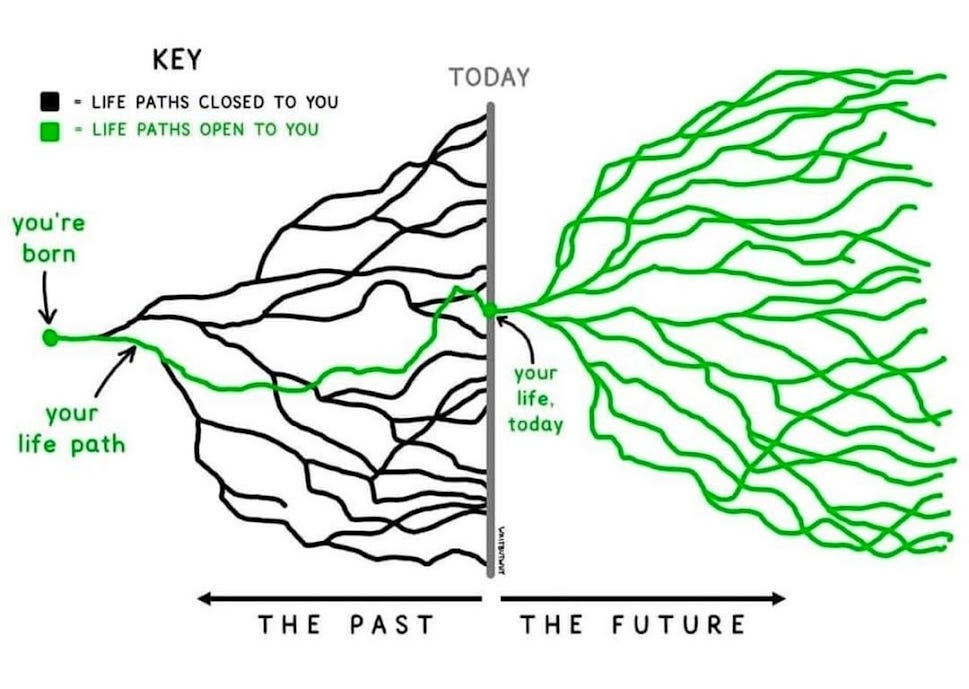
Here the Self begins to author its own life more consciously and with specific intention. The person can examine inherited beliefs, choose values, and start living from an internal compass rather than only from expectation.
Life feels like a new reality because they now say: “I can choose the story I live inside.” In our home we love the iconic line from Hamilton: An American Musical, sung by the character Aaron Burr: “I am the one thing in life I can control. I am inimitable, I am an original”.
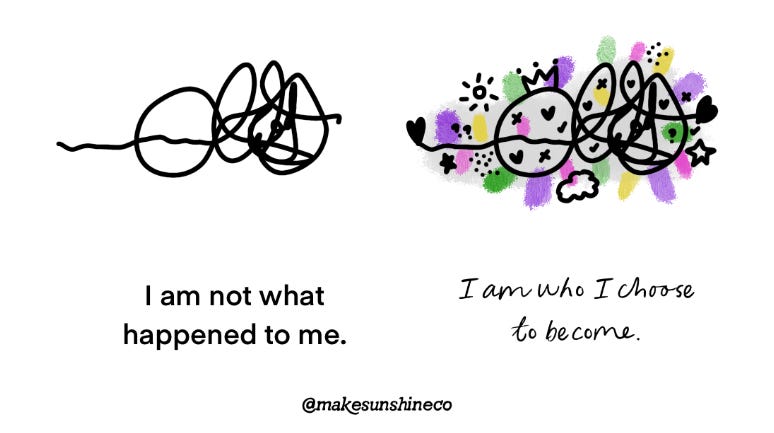
“I am not what happened to me, I am what I choose to become.” -Carl Jung
Manifesting is going to enter the Observer’s lexicon more here too. The feeling that you “wish” for something and it just magically unfolds without effort gives the word “manifesting” a whole new interpretation. Choices and decisions feel like floating on a river, taking you where you want to go not because you are impartial but because you have become more flexible about how you get there.
It is a powerful dimension of consciousness because it creates dignity. The person is no longer only an actor in the play. They can revise the script and improv easily.
The test is whether you can stay here without rushing to hand your story back to someone else. Moving into this level is often socially and mentally disruptive, because life begins to discard the ways you used to operate. You may outgrow old habits, relationships, and roles faster than the people around you, and in that shift you can shed close friends who aren’t ready or able to follow.
This uncertainty can also make you more vulnerable to rigid religious, spiritual, or cult‑like systems that promise certainty at the price of your agency. You hand over your own authority to an external leader, doctrine, or group, because the weight of self‑authorship feels heavier than the comfort of being told what to believe.
There is a tendency to become more serious, more intentional, and sometimes more isolated. I guess because choosing your own story is freeing, but it also removes the shelter of borrowed certainty.
To test this: notice whether you ever consciously ask, “Is this belief really serving me?” or “Do I need to hold this identity so tightly?” Being curious about how you feel is a superpower in this dimension.
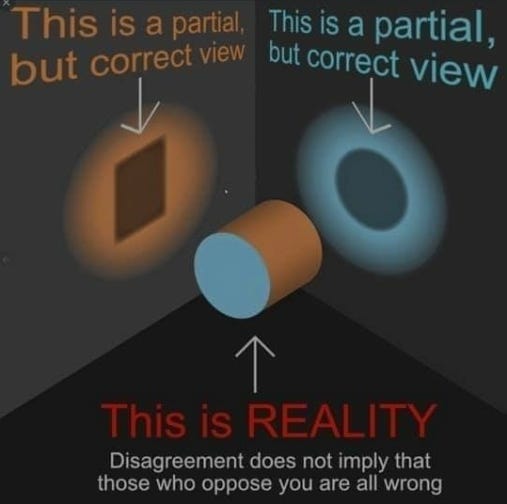
Near the edge of this dimension, you’re capable of holding multiple conflicting ideas at the same time, recognizing that all are valid when details are received inconsistently. This realization opens you to “no single perspective actually conflicts with another.”
6D — Perspective on perspective
The Self can still have convictions, preferences, and strong opinions, but it also begins to see that its way of interpreting reality is not reality itself. Other people are not merely people who arrived at different conclusions than we did; they are moving through their own histories, fears, loyalties, and inherited meanings. Their “truth” is not a distorted copy of yours; it is a different configuration of the same raw material.
And then comes the quieter “duh”: even the stories we thought were chosen may have been borrowed. Some were handed to us by family. Some were absorbed from culture. Some were adopted because they helped us survive a moment we didn’t know would become a pattern. We didn’t always notice when a belief became part of our identity; we only noticed how threatened we felt when it was questioned.
At this level 6 dimension, the Observer may begin to feel phrases like: “My story is one of many possible stories.” Not “my story is fake,” and not “everyone is equally correct,” but something softer and more spacious than either of those.
The point is not to erase discernment. It’s to stop confusing familiarity with truth.
To test this: notice whether you can listen to someone you strongly disagree with without immediately rehearsing your rebuttal. Can you let their perspective exist long enough to understand why it makes sense to them? Can you revise your own view without feeling that you have been diminished by the revision? Can you hold your imagination, your memory, and your interpretation without assuming they are the final frame?
This is an important realization. A person is no longer ruled by belief in the same way. They can hold beliefs more lightly, examine them more honestly, and let them breathe. Wisdom begins to look like humility, instead of certainty. Less like “I know,” and more like “I can see how I got here.”
7D — Systems
Now the mind starts to notice patterns and networks: feedback loops, incentives, roles, and structures visible from the 7th dimension. The person sees that individuals are shaped by systems, and systems are shaped by individuals—neither is fully reducible to the other.
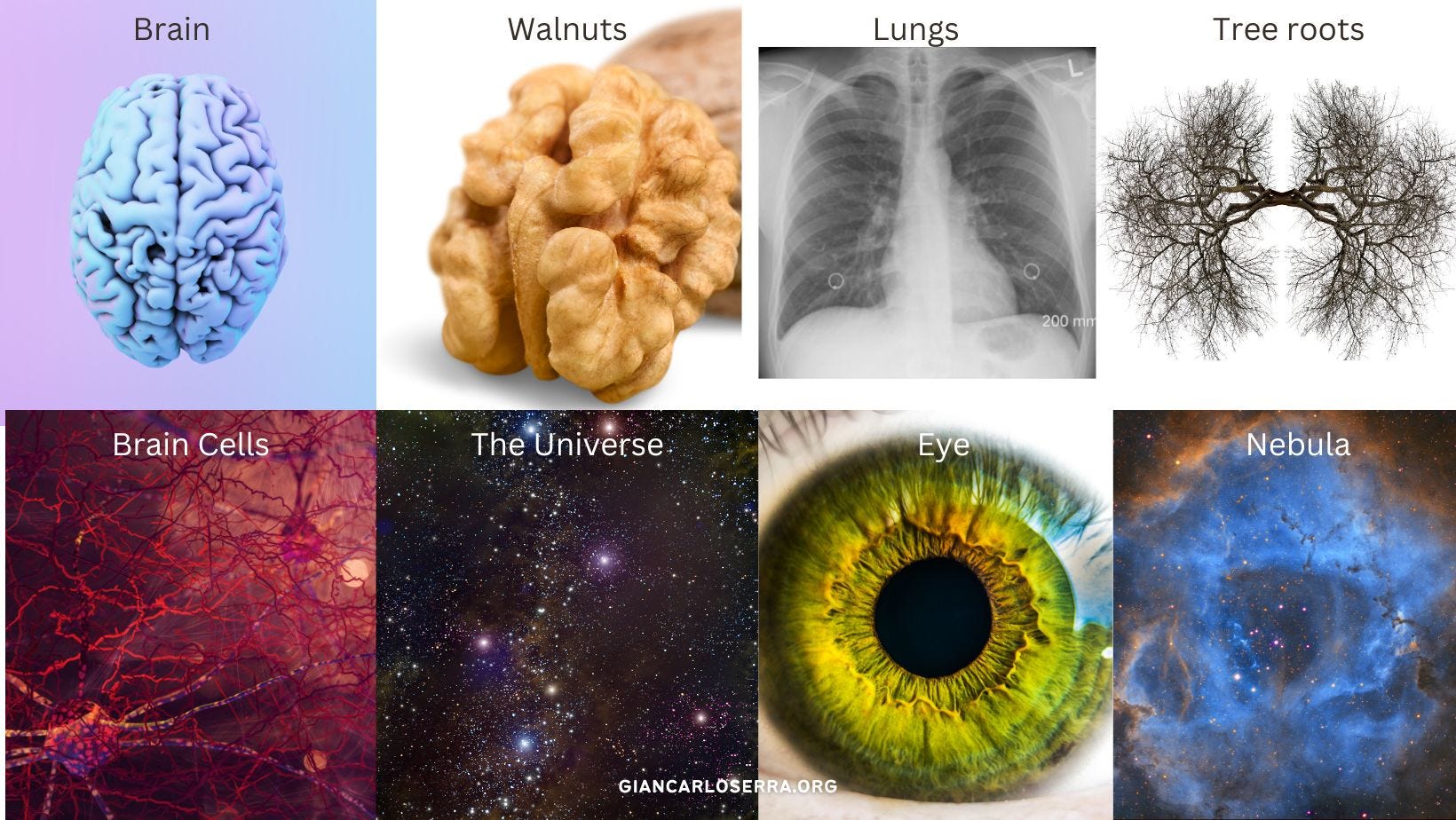
A person here might say: “You are not a drop in the ocean. You are the entire ocean, in a drop.” Rumi did.2
To test this: Can you talk about a situation and locate the roles, incentives, and unseen pressures that everyone inhabits, including yourself? If you imagine a clock, every gear is necessary; stop one, and the whole mechanism stalls. The test is whether you can think in terms of gears, not just “good people” and “bad people.”
This level tends to make people less naive because they can see how the same intentions lead to different outcomes in different systems. It also makes them more patient because they can see that good people in a bad structure often do harm and that good people in a better structure can do far more than their goodness alone would suggest.
The world isn’t just made of people. It’s made of patterns: institutions, histories, habits of power, and invisible rules that shape how we move, speak, and decide. Awareness at this level is not cold or detached; it’s a kind of structural clarity that makes compassion more precise, not less real.
8D — Non-duality
Here, the separation begins to thin. Opposites are still visible, but they are no longer absolute enemies. The Observer starts to sense that what looked like contradiction may actually be complementary. “Good and bad are two sides of the same coin. Locked in a relationship.” Karma begins to feel less like punishment or reward and more like a turn in a shared pattern—simply your moment to take it.
Some might even notice that experiencing the pain first can make the pleasure sharper, and experiencing the pleasure first can make the pain more pronounced. The Observer no longer tries to split reality into “good side” and “bad side,” but begins to feel the whole cycle as one movement.
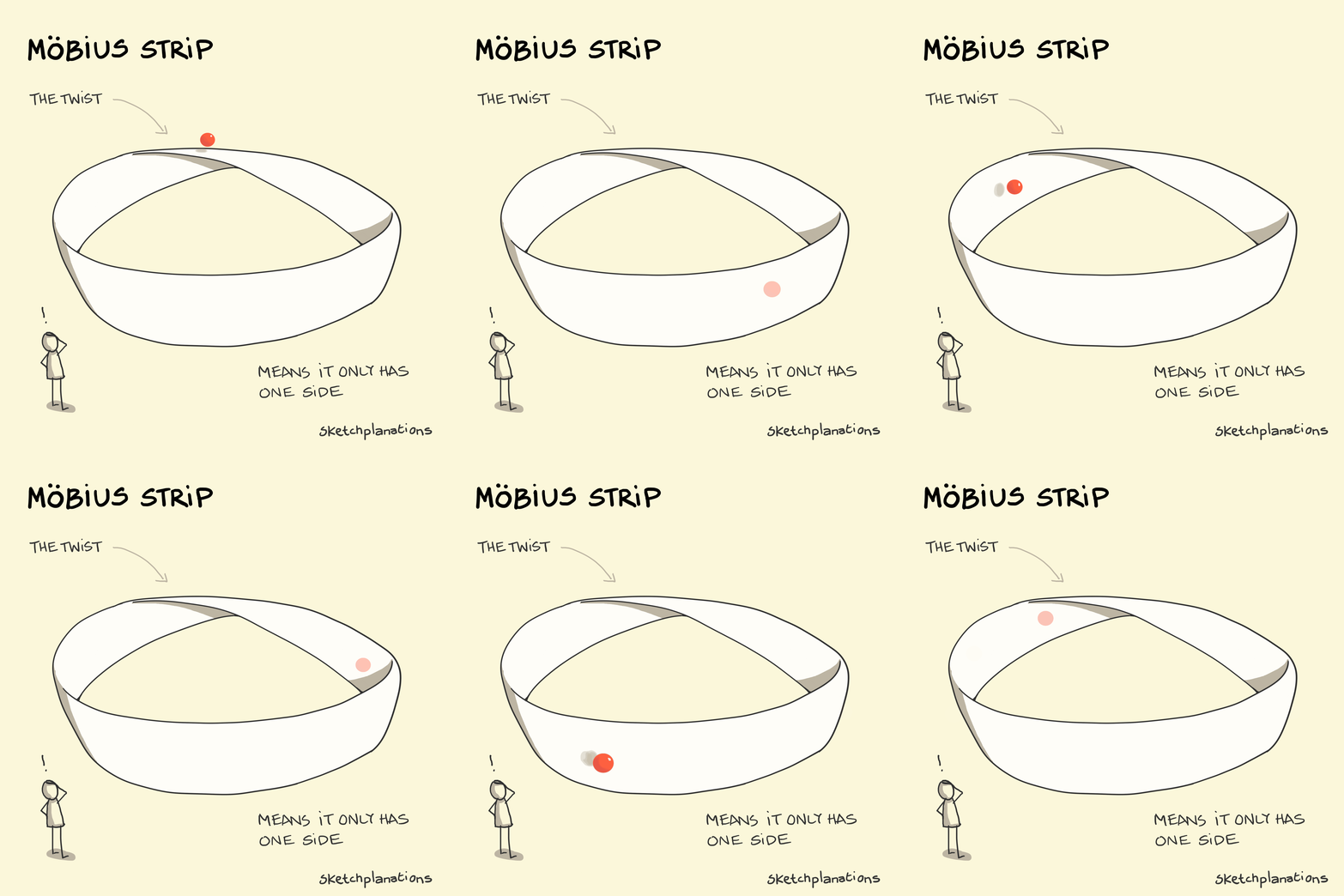
But the dimension of consciousness holds a quiet version of non‑duality. It isn’t ecstatic; it is calm. It’s the feeling that a loss can also contain a gain, and that a gain can contain a loss.
To test this: Can you can hold paradoxes without needing resolution? We are a unity that contains them.3
9D — Suchness
Then comes the deeper release. Even the coin disappears. The distinction between duality and non-duality is seen as conceptual. There is no longer a need to stand outside reality and label it. “It all simply is.” or “I am.”
This is not apathy nor is it passivity or nihilism. It is the collapse of the last unnecessary division.
This is not a dramatic state. It can be ordinary and mundane. It can be the moment you notice a tree without wanting it to mean something. You just see the tree, notice the light on its leaves, hear the sound of the wind, and simply acknowledge the feeling in your chest, and that is enough.
To test this: Can you let a thing simply be itself? A tree is just a tree. A feeling is just a feeling. A moment is just a moment. Nothing more needs to be added.
This can also be experienced as a Void (not to be confused with a “nothingness” that swallows you, but a “potentiality that sustains you”).
A final note
You do not need to reach 9D to matter. You do not need to “live in 5D” to be real. Consciousness is not a race to the top. It is a gradual lens you see the things around you happening through. Ever evolving and growing with you.
If anything in this framework feels too neat, trust that feeling. It probably is too neat. The real work is not in perfecting the model, but in noticing how your own experience shifts from moment to moment, from 1D to 4D, from 7D to 3D, and back again.
You, dear Observer, already exist throughout all of these dimensions. Maybe now you’ll see them more.
For younger readers: there was once an entire advertising campaign built around the idea that one night at a Holiday Inn Express could temporarily simulate competence.
Rumi, the 13th Century Persian poet, provides us with profound insight & understanding. He offers us another perspective to consider when contemplating our smallness. As Rumi describes, “you are not just a drop in the ocean, you are the entire ocean in a drop.” We are not insignificant for being small. Rather, we are each a reflection of the larger whole. Together, we are all a part of something much, much bigger!
This is a pretty impressive revelation.
This is where yin and yang comes to mind—not as a simple good-versus-bad model, but as a reminder that opposites often belong to the same living pattern. The Möbius strip is just my very modern way of saying the same thing, with slightly more geometry and slightly less poetry.
I’m always so touched and impressed with the wholeness of what you put out, Joseph. Beautiful and helpful.